article class="project-detail">
← Back to projects

Stay Nimble

An AI-powered career coaching platform for people from disadvantaged backgrounds. Redesigned from a passive skills-matching tool into a guided, end-to-end career change journey — growing from 1,000 to 11,000 users and expanding from local-authority contracts to a direct-to-consumer subscription model.

Role Product Designer
Timeline 10 months
Team Product Designer · Product Manager · 3x Engineers · Data Scientist
UX DesignCareer TechJourney DesignB2C Pivot
11,000 Total users (up from 1,000)
38% Journey completion rate (up from ~12%)
43% Increase in coach pairings
01

The Problem

Stay Nimble started as a skills-to-jobs matching tool: users could compare their CV skills against in-demand roles, but had no guidance on what to do next. The audience — people in low-paying jobs with long hours and little margin for error — faced high psychological barriers to career change: uncertainty, overwhelm, and low belief that a transition was even possible for them. Career coaches existed, but operated outside the product in Intercom, disconnected from the journey. And the business model was limited to local-authority contracts, with no direct-to-consumer revenue.

02

My Role

I contributed to discovery, UX design, and the end-to-end journey redesign within a broader product team. Within that, I drove the design of the five-step journey structure, the nudge-based re-engagement patterns, and the concept for the B2C coaching-block model.

03

Discovery

I focused on the psychology of career change for this specific audience: transitioning roles requires sustained motivation, and our users had very little margin for failure: any friction in the product risked being fatal to their attempt.

HotJar and Google Analytics quant data showed the pattern: users arrived, then left. The qualitative picture explained why: they simply didn't know where to go first. The homepage offered skills comparison and job listings, but no path. It was like handing someone a map of a city without telling them which street to walk down. The insight: users needed a structured journey, not another dashboard.

Insight

It was like handing someone a map of a city without telling them which street to walk down. Users needed a structured journey, not another dashboard.

04

Design Decisions

A five-step guided journey

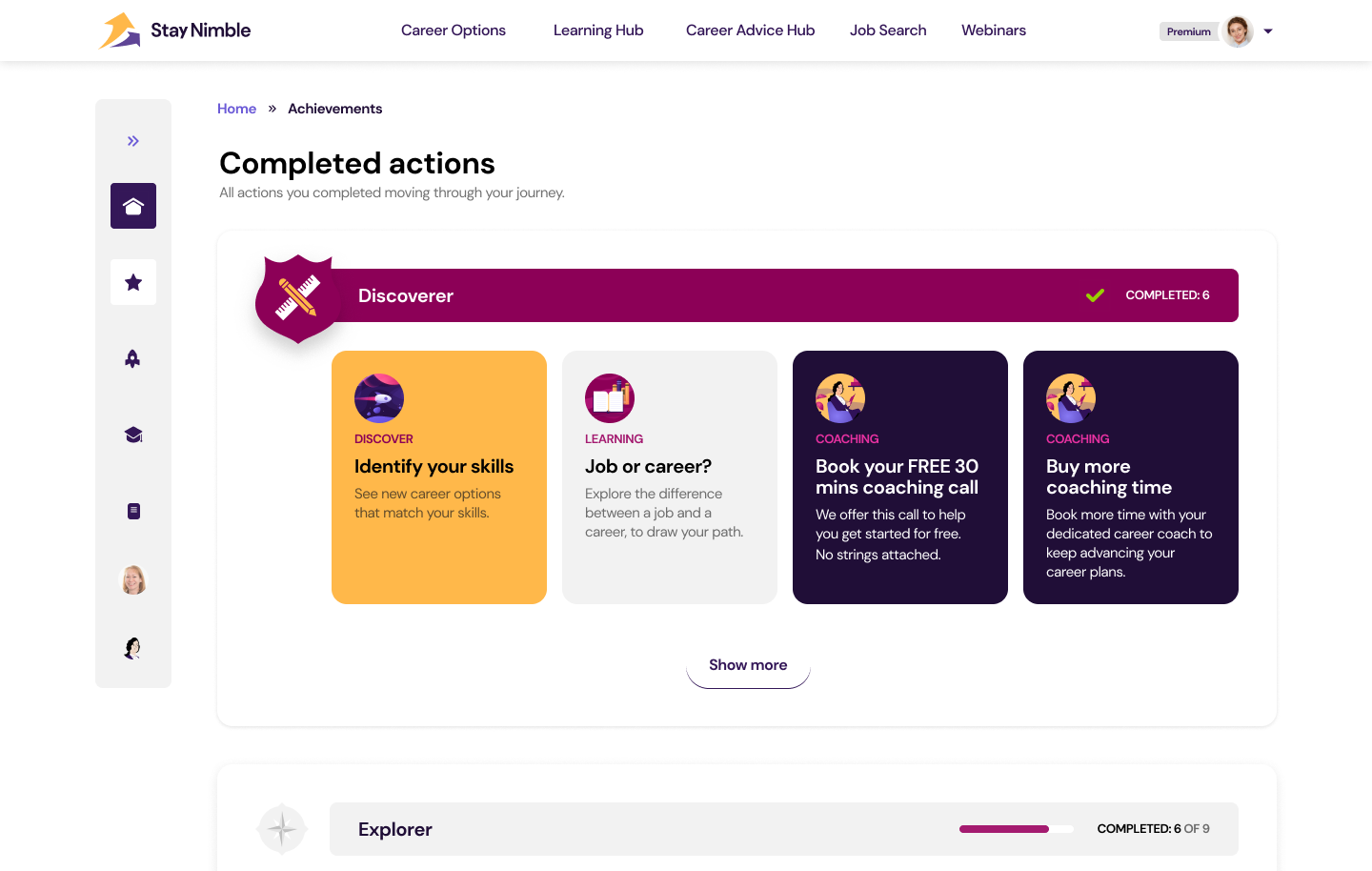
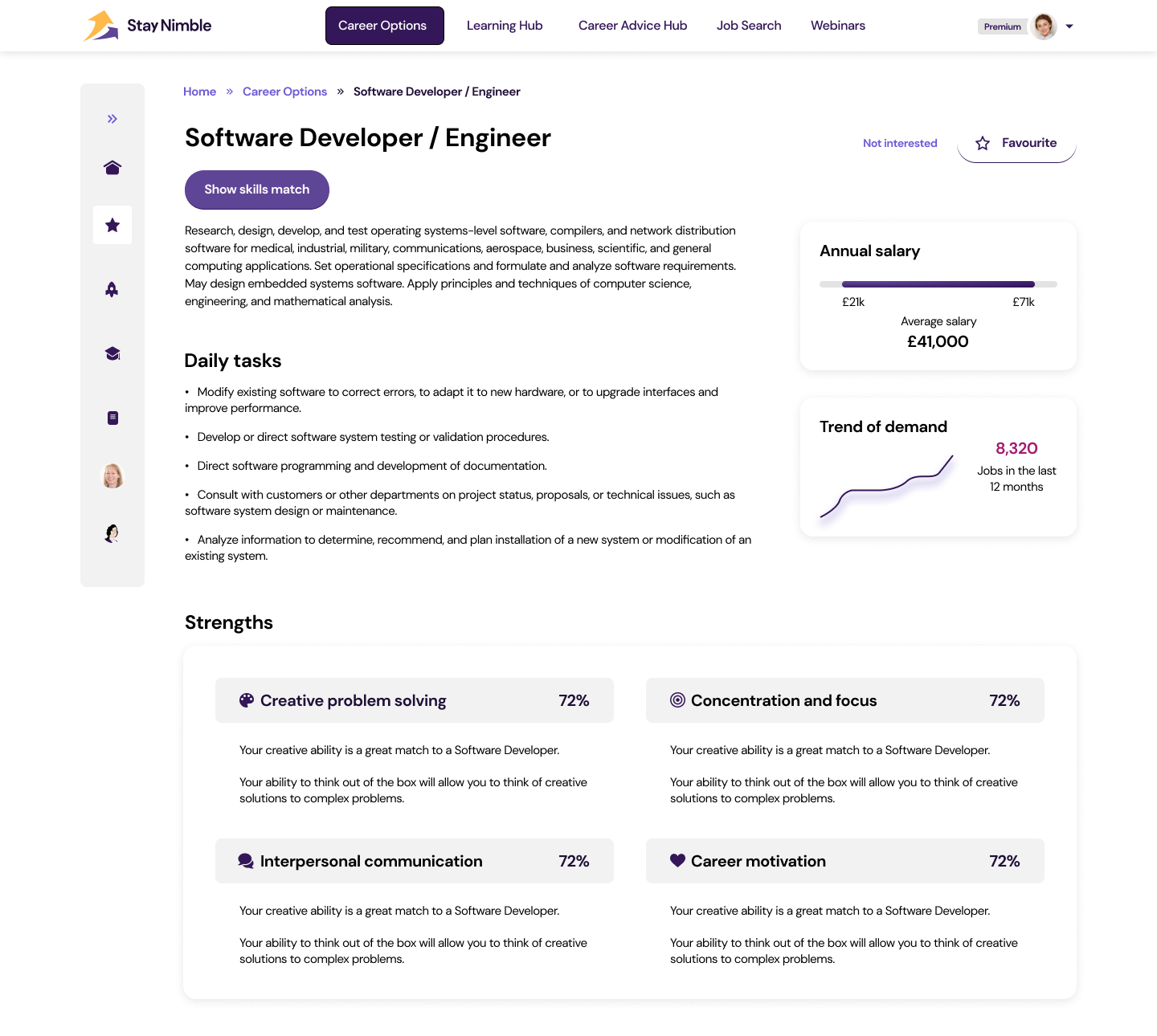
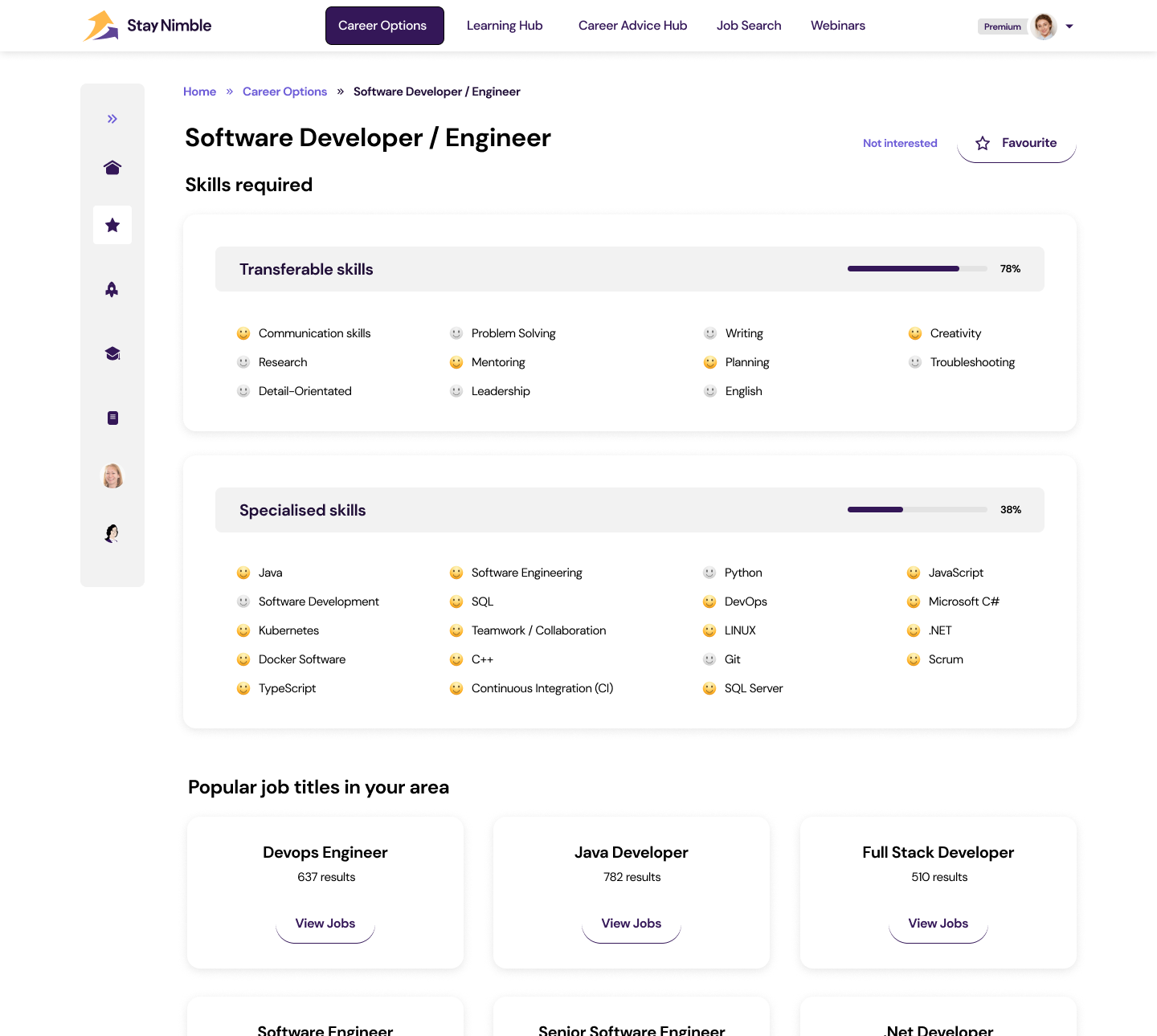
I proposed structuring the product around five sequential steps — identify your skills, discover your strengths via a psychological assessment, do some learning, book a coaching call, search for jobs — each with a clear next action and no dead ends. The sequence was designed to build confidence progressively, not demand a leap from assessment straight to application.

5 step process

Nudge-based re-engagement

Given the audience's limited time and low baseline confidence, I designed nudges that prompted users to continue at their own pace if they stalled mid-journey, with coaching offered as a defined block rather than an open-ended commitment.

Drip-fed learning via Open University

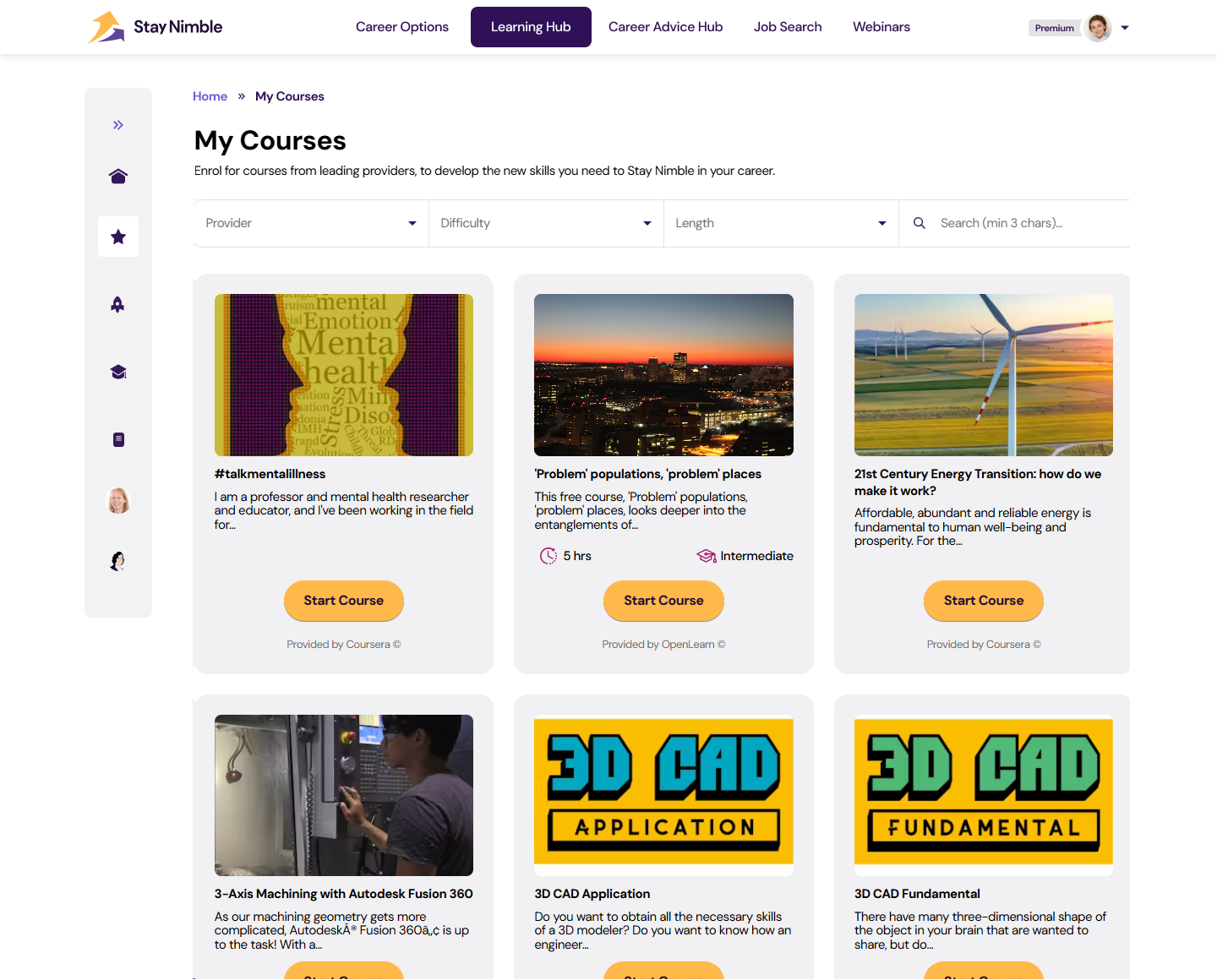
We partnered with the Open University to surface relevant courses inline with career recommendations at the learning step, matched to the gap between a user's current skills and their target role, and pacing-friendly rather than requiring a traditional course enrolment.

Learning hub

Embedding jobs and coaching in the journey, not beside it

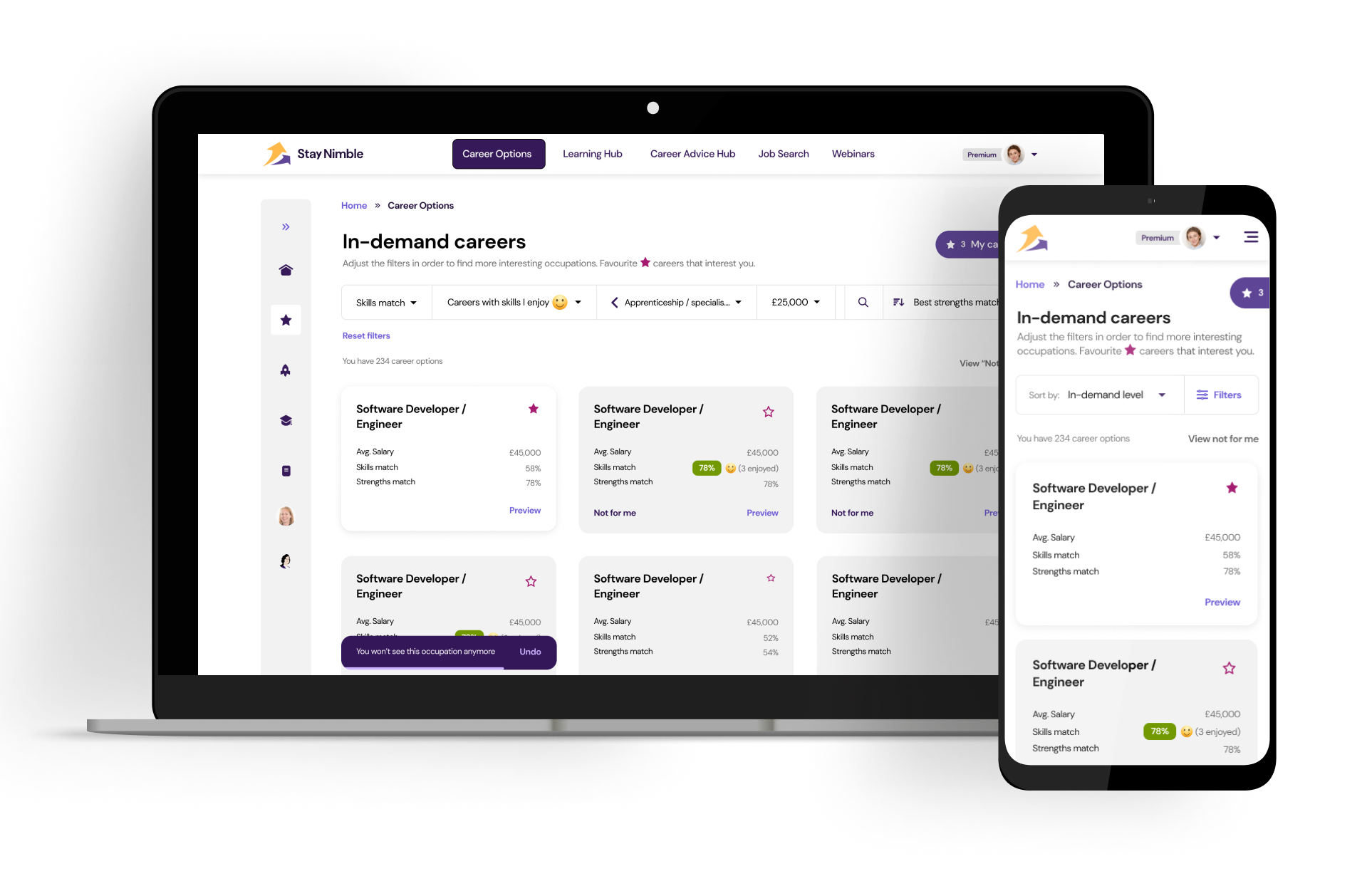
Indeed-powered job listings appeared within the career page itself, and career coaching — CV reviews, LinkedIn reviews, interview practice — was offered as timed blocks within the same flow. A user could go from assessment to course to coaching to application without leaving the product.

Designing for a B2C pivot

The original model relied entirely on local-authority funding. I contributed to designing the subscription and coaching-block layer that let the same journey be sold directly to users, opening a revenue stream independent of public-sector contracts and extending reach beyond the original geographic catchments.

05

The Challenge: Pushback on the Five-Step Model

The first version was passive: it showed skills, compared jobs, and expected users to connect the dots themselves. For a cohort already daunted by the idea of career change, that was enough to make them quit.

Warning

The Pushback: When I proposed the five-step linear journey, it wasn't an easy sell. Stakeholders argued career changers wanted flexibility, not a rigid checklist, and worried a fixed sequence would feel patronising and increase drop-off.

I countered with the HotJar data: users were already dropping off precisely because they had no direction. The linear journey wasn't a constraint, it was a guardrail. We kept the original skills comparison, but it became step one of five, not the whole product.

Impact

The Counter: users were already dropping off because they had no direction. The linear journey wasn't a constraint, it was a guardrail.

06

Outcome

  • User base grew from 1,000 to 11,000 (1,000% growth)
  • Journey completion rate increased from an estimated 12% to 38% within two months of relaunch
  • 87% of users engaged with career recommendations; coach pairings increased 43%
  • Helped open a B2C subscription model alongside the original local-authority contracts, with Open University and Indeed partnerships closing the skills-to-employment gap
07

What I'd Do Differently

  • Quantify drop-off rigorously before and after the redesign, rather than relying on estimates
  • Bring career coaches into the product design process earlier, so their content is structured around the five steps from day one
  • Test the subscription model with users before committing engineering resources to billing infrastructure
  • Build in flexibility for users to skip steps they've already completed elsewhere, sooner than we did

From Stuck to Nimble

Stay Nimble transformed career change from a daunting leap into a guided journey. By combining behavioural psychology, data science, and human coaching, we didn't just help people find jobs, we helped them discover who they could become.

“I never considered UX design, but seeing my skills match and the salary potential... I'm enrolling in a course next month. This platform gave me a direction I didn't know existed.”

— Stay Nimble Member